Affordable housing for everyone: What citizens want to see happen
Citizens from across Europe propose concrete solutions to the problem of housing affordability in a virtual assembly launched by the EU-funded project MultiPoD
Reinvesting part of the profits generated by tourism rentals into social housing and local development, transforming unused public buildings into social housing, diversifying housing models and regulating rents, integrating housing with social services, and repurposing vacant public and church-owned buildings to increase affordable housing are some of the key ideas proposed by citizens and experts to address the problem of housing affordability in Europe.
Earlier this month, the European Commission presented its first-ever European Affordable Housing Plan, in response to a housing crisis that is increasingly affecting millions of people across Europe. The plan sets out a shared European approach to improving access to affordable, sustainable and good-quality housing, including measures such as increasing housing supply, promoting investment and reforms, and taking action on short-term rentals in areas with housing shortages, among others.
In this context, initiatives such as the EU-funded MultiPoD project are opening up multilingual and multicultural spaces for public deliberation around the most urgent issues facing citizens, like housing. The project, led by webLyzard technology (Austria), has brought together a consortium of leading research, technology and social innovation organisations composed of Decidim Foundation (Spain), ETHOS Lab (Greece), KMOP (Greece),Open Source Politics (France),The Open University (UK), Re-Imagine Europa (Belgium), Storypact (Austria), and the NOVA University of Lisbon (Portugal).
As part of this effort, on 12 November 2025, MultiPoD gathered online more than 100 participants from across Europe to take part in the Citizens’ Dialogue on housing, organised by KMOP Social Action and Innovation Centre. The discussion brought together citizens, experts, young people, migrants, and individuals facing housing challenges to explore how housing systems can become more affordable, inclusive, and sustainable.

Moderated by Dr. Antonis Klapsis, Vice President of KMOP and Assοciate Professor at the University of the Peloponnese, the online Dialogue combined expert reflections with small-group deliberations, enabling participants to share experiences, learn from one another, and collaboratively draft recommendations for better housing policies to be forwarded to policymakers, researchers, and civil society partners.
“In many cities across Europe, rents are rising faster than wages, forcing young people and low-income families out of their neighborhoods. Home ownership, once a realistic dream, is slipping out of reach for large parts of the middle class. In some regions, whole generations now face the prospect of permanent housing precarity. Meanwhile, short-term rentals are reshaping urban landscapes. Today’s online dialogue gives us a great opportunity to look closely at what works, learn from each other’s experiences, and reflect on how Europe can once again make housing a cornerstone of fairness and opportunity”, Mr. Klapsis stated.
Expert Insights on Europe’s Housing Landscape
Participants also heard from a panel of distinguished experts who offered valuable insights into the multiple dimensions of Europe’s housing landscape. Mr. Michalis Goudis, Director of the Heinrich Böll Stiftung Thessaloniki Office, discussed the role of municipalities and community-led initiatives in addressing local housing challenges. Mr. Ilias Nikolaidis, Content Director at diaNEOsis Research and Policy Institute, highlighted the importance of long-term strategies that can create more equitable and resilient housing systems.
Dr. Dimitra Siatitsa, Postdoctoral Researcher at NTUA and EKKE, examined how urgent measures such as rent controls can be balanced with sustained public investment in affordable housing stock. Dr. Maria Karagianni from the Major Development Agency Thessaloniki S.A. presented examples of innovative and alternative housing models across Europe. Dr. Eva Papatzani, Research Associate at EKKE, explained why stable housing is a cornerstone for the successful integration of migrants and refugees, while Dr. Angeliki Mitropoulou, Research Associate at the ENA Institute for Alternative Policies, emphasized the impact of tourism and investment schemes such as the Golden Visa on access to housing, as well as the challenges of keeping homes affordable for local residents.
Υοu can watch the event here.
The top-five key recommendations for better housing policies
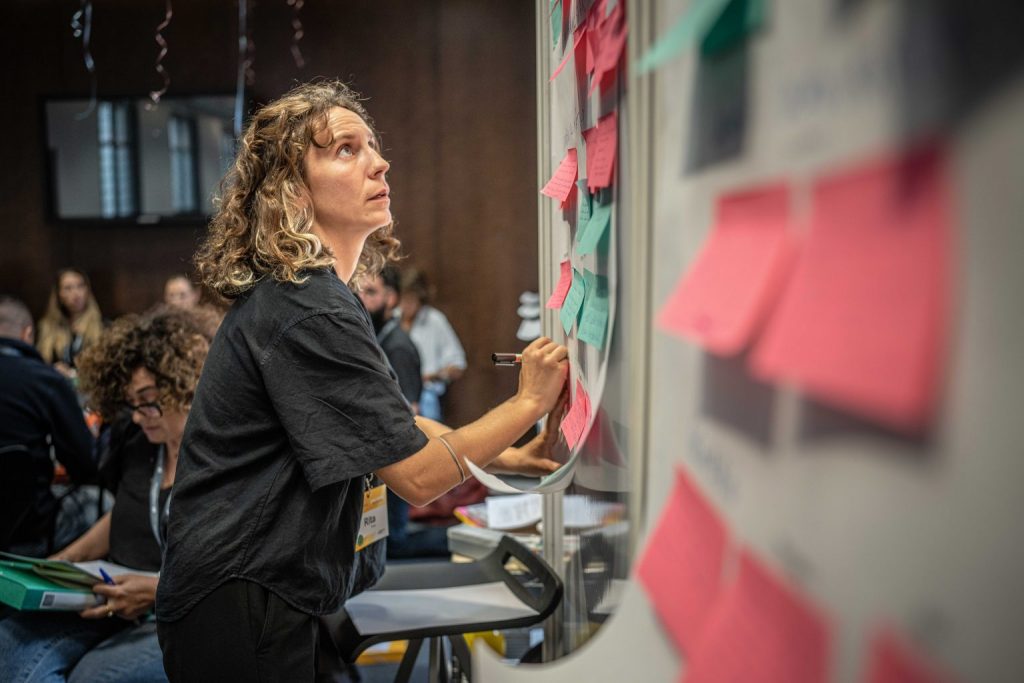
Participants worked collaboratively to share personal experiences, identify priorities, and developed five recommendations that reflect their collective insights.
- Link tourism revenue to local development
Introduce tourism levies and reinvest revenue in local services such as housing, public transport, and community infrastructure.
- Reuse vacant buildings
Convert unused public buildings into social housing and offer incentives for private owners to rent vacant units affordably, with municipalities acting as mediators.
- Diversify housing models & regulate rents
Support cooperatives and non-profit housing through public land and affordable financing, and strengthen rent reference systems and tenant protections.
- Connect housing with social inclusion
Integrate housing with health, employment, and social services, create one-stop support centres, and promote mixed-community and co-housing models.
- Expand social housing
Repurpose vacant public and church-owned buildings to increase affordable housing and support social inclusion and urban renewal.
A collective effort for fairer housing policies
The dialogue demonstrated the value of inclusive, citizen-centred processes in shaping policy. By bringing together residents from diverse backgrounds: tenants, homeowners, young people, migrants, and individuals facing housing insecurity, the event highlighted that meaningful and practical solutions emerge when those most affected have the opportunity to contribute directly.