
Inside MultiPoD’s Pan-European Policy Assembly on Affordable Housing: a live multilingual debate connecting citizens with EU policymaking
On 22 September, MultiPoD’s inaugural policy assembly demonstrated how advanced multilingual tools can streamline cross-border civic engagement on EU legislation. Nearly 200 participants, including more than 140 policymakers from all levels of public administration together with civil society representatives and citizens, from 20 EU member states to deliberate on the European Commission’s Affordable Housing Act. The session allowed participants to evaluate how real-time translation can overcome traditional language barriers and make cross-border civic deliberation genuinely inclusive.
How can people from different cultural and linguistic backgrounds take a meaningful part in shaping the policies that affect their lives? This is the question at the heart of MultiPoD, and the one its first Policy Assembly set out to explore by combining citizen deliberation, dialogue with policymakers and digital technologies designed to make democratic participation more accessible across Europe.
Thirteen days after the European Commission presented its Affordable Housing Act, Re-Imagine Europa convened the Assembly as part of its work on digital democracy within the project. The online event gathered more than 140 policymakers from all levels of public administration, together with representatives of civil society and citizens.
The Assembly had two aims. The first was to open a European conversation on one of the most pressing social challenges of our time. The second was to test, in a live setting, whether the tools built by the MultiPoD consortium over the past year could allow people who speak different languages to take part in the same debate on equal terms.
A European challenge that calls for European dialogue
Housing affordability has become an urgent concern across Europe, affecting millions of citizens and with consequences for social cohesion, economic security and equal opportunity. Over the past decade, house prices have increased by more than 60% and rents by more than 20%, while 51% of people living in European cities consider housing an immediate and urgent problem where they live. Fair and accessible housing is now a key priority for EU institutions, closely linked to social inclusion, sustainable urban development and citizens’ well-being, and the Commission’s new proposal placed this debate at the centre of current European policymaking.
MultiPoD was created to open European political debate to citizens of every language and culture, at a time of growing polarisation, disinformation and declining trust in democratic institutions. The project pays particular attention to those who are most affected by policy decisions but rarely involved in shaping them. The Assembly, under the event Multicultural and multilingual e‑democracy at work: A multistakeholder debate on Housing Affordability in Europe, developed in collaboration with the IDEAL project, followed this approach, inviting participants to share their experiences and discuss how their priorities could inform housing policy at European and local level.
From citizen concerns to European policymaking
The conversation built on the previous MultiPoD Citizens’ Assembly, organised by KMOP – Social Action and Innovation Centre, in November 2025, where participants identified five priorities that served as a starting point for the discussion: bringing vacant buildings back into use; diversifying housing models and strengthening rent protections; linking housing with social inclusion; expanding social housing; and reinvesting tourism revenues in local communities.
Moderated by Erika Staël von Holstein, Chief Executive of Re-Imagine Europa, the debate brought together a high level panel featuring Lars Svensmark, Communications Representative of the Housing Task Force at DG Energy, European Commission; Michaela Kauer, Director of the Brussels Office of the City of Vienna; Anne Andersson, Managing Director of the Stockholm Region EU Office; and Laia Segura Cueto, Head of the Representation of Barcelona City Council to the EU.
Despite their different approaches, the three speakers agreed on the importance of long term investment, public action and solutions adapted to local realities. This diversity of experience is precisely what a European debate can bring to light, offering a richer understanding of the challenge than any single model could.
Technology at the service of participation
What made this exchange particularly significant was the way technology allowed participants to engage with the debate as it unfolded. Rather than defaulting to English, relying on translated discussions held at different times, or keeping debates within national borders, the Assembly brought together three tools developed by the MultiPoD consortium, each covering a different stage of participation.
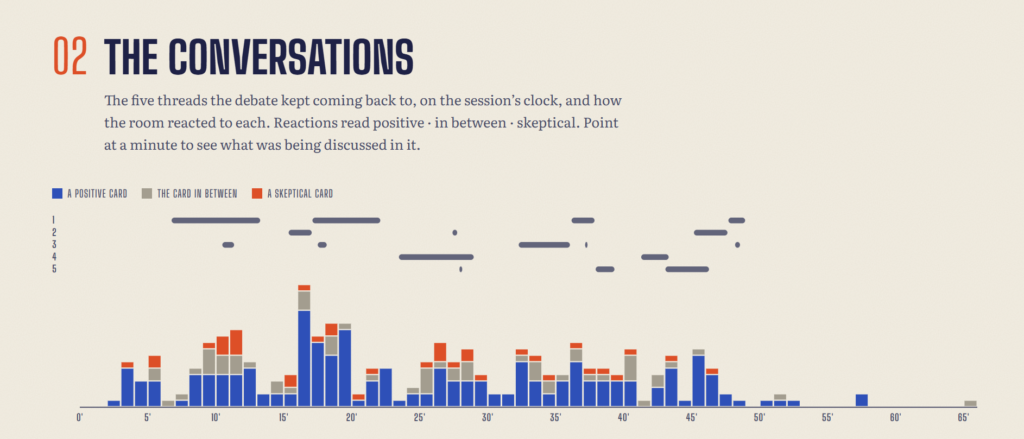
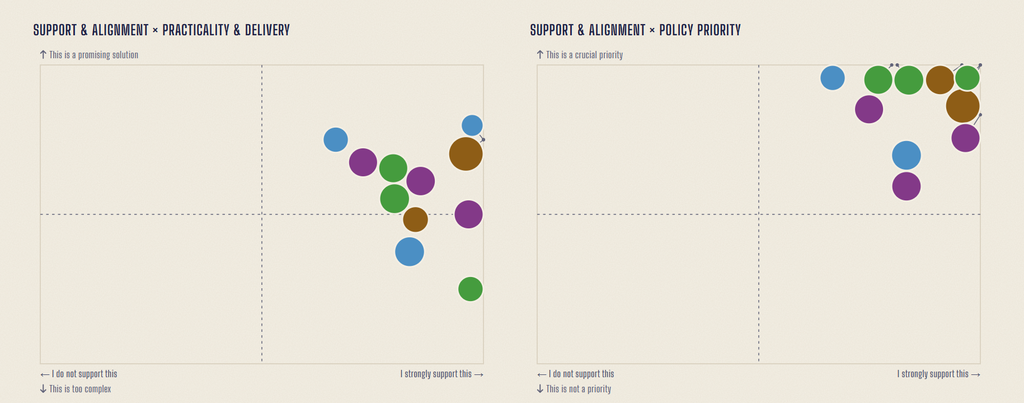
- At the heart of the live debate was Democratic Reflection, developed by The Open University in the United Kingdom. The tool supports live transcription and translation in 34 languages, including all 24 official EU languages, and ten of them were used during the event. Participants could react to specific moments and arguments through interactive reflection cards in their own language, indicating their level of support and assessing whether a proposal seemed practical, how urgent it was and whether it could apply in their own city, while open comments offered an additional channel for sharing their views. Every reaction was instantly translated, timestamped and linked to a specific moment in the debate, and a live facilitator dashboard gathered responses as the conversation unfolded, allowing organisers to identify emerging themes and bring audience questions directly to the panel. By the end of the debate, more than 300 reactions had been collected. From this data, the tool produces a multilingual report that maps how the discussion developed, identifies its main themes and compares responses across audiences, while indicating how much weight the data can carry. By connecting reactions to particular arguments, it reveals where views converge and where they differ, and makes it possible to examine not only whether a proposal is supported, but whether people consider it feasible and relevant to their own circumstances.
The full report is available here.
- The webLyzard Visual Analytics Dashboard, developed by webLyzard technology in Austria, placed the debate within its wider context. Using natural language processing, it tracks European news, research and institutional media on housing by location, sentiment and topic, connecting what was said during the Assembly to the broader public conversation on housing policy.
- Before and after the live session, participation continued on Decidim, the open source participatory platform originally designed by Barcelona City Council. Participants used it to review briefing materials, submit proposals and vote on priorities before the debate began, and the platform will host a report combining the Assembly’s analytics results, keeping the conversation open as the process moves forward.
What comes next
The Assembly was not only a discussion about housing, but also a first step towards making European policy debates more multilingual, inclusive and connected to citizen participation. The consortium is now reviewing participant feedback and data, and the outcomes of the debate will contribute to policy recommendations that connect citizen priorities with decision making at European and local level.
The journey continues in May 2027, when MultiPoD will hold its next Citizens’ Assembly, building on the technologies tested in September and focusing on a theme drawn from the Conference on the Future of Europe. By exploring an issue that resonates with people’s everyday experiences, it will offer another opportunity for European residents, particularly those from multicultural and multilingual backgrounds, to help shape the future of Europe.